Tuesday, 26 April 2016

All-Shakespeare Poetry Session to Commemorate the 400th Death Anniversary – Apr 22, 2016


We had eight regular readers and a guest, Joe's son Reuben, who was visiting from USA. The first time we had an all-Shakespeare session was on May 9, 2009 at Talitha's suggestion:

Thommo, Reuben, KumKum, Zakia

 Sonnets and plays were the source of inspiration for readers at this 2016 event to commemorate the 400th death anniversary of William Shakespeare. The Bard is better known in India than in Britain according to a recent survey:

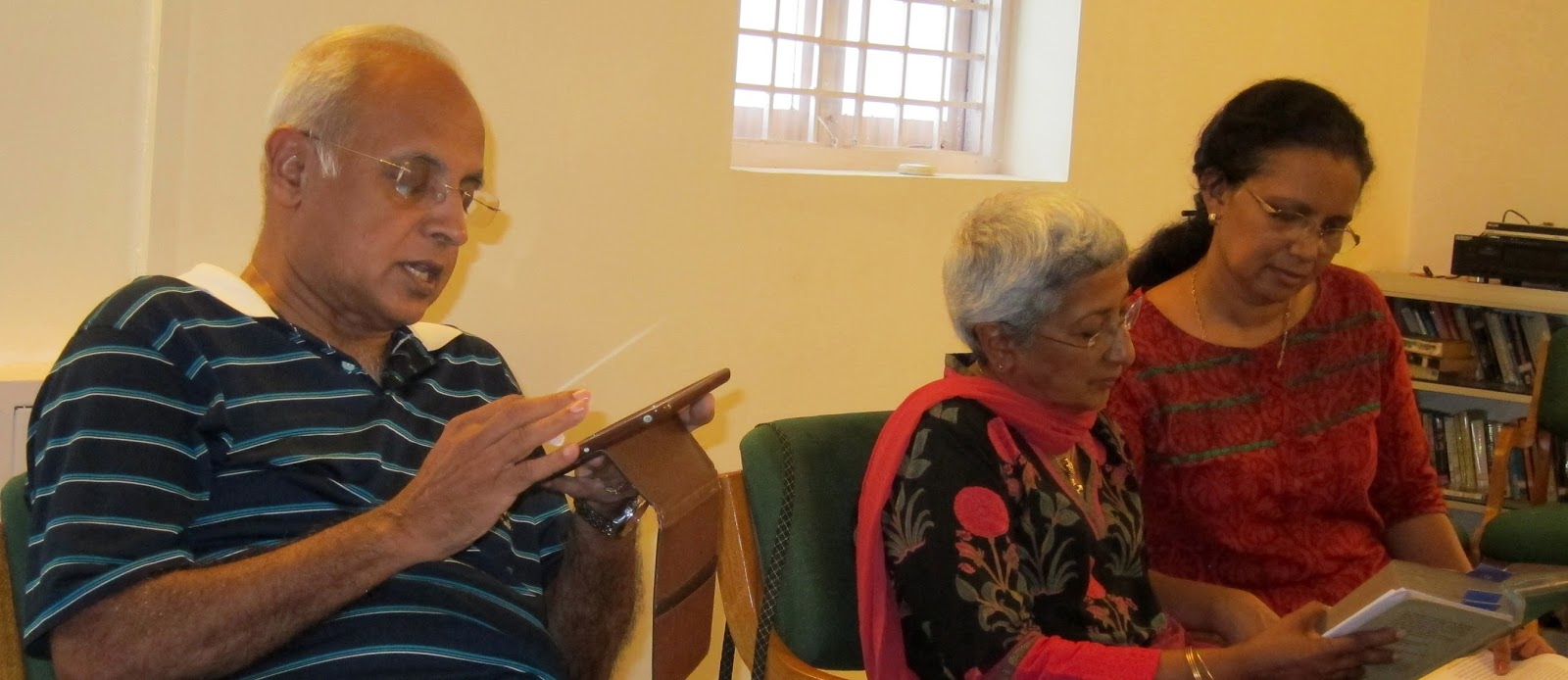
 Zakia, KumKum, Priya

From polyamory and anti-Semitism to the madrigal poetic-musical form and Original Pronunciation, the discussions were open-ended and contemporary. Which demonstrates how relevant Shakespeare continues to be 400 years after his death.

Thommo, Ammu, Shoba

 For a tour of Shakespeare's 400th anniversary being celebrated in Stratford-upon-Avon, consult BBC at

Joe & Gopa


Reuben has provided a video on youtube that records the session for 25 minutes:
https://www.youtube.com/watch?v=PcOPHkkqQPw

We missed Talitha, and five other readers who were absent for unavoidable reasons. But here we are at the end, smiling with our guest, Reuben, who took many of the pictures at this session. 


Priya, Thommo, KumKum, Reuben, Ammu, Gopa, Shoba


Friday, 1 April 2016

Commemorating Shakespeare's 400th Death Anniversary on Apr 23, 2016


Cobbe Portrait of William Shakespeare, ca. 1610, Artist unknown, oil on panel. Collection of Archbishop Charles Cobbe (1686–1765)

No poet has figured oftener on this blog than William Shakespeare (WS). His sonnets, his plays, and his long poems have been the subject of numerous readings at KRG.
Twice we have celebrated his birthday (Apr 23, 1564) with all-Shakespeare readings. And on his 450th birthday we sponsored a week-long celebration in Fort Kochi which is recorded in eight posts on this blog in April 2014. There were workshops in acting, a one-man Shakespeare play world premiere, excerpts from his plays by college performers, lectures, a puppet show and Elizabethan singers.


Each age will re-discover WS and find that resonance which makes him the Universal poet expressing the thoughts and sentiments of humankind everywhere. Poetry may undergo elemental changes from Symbolism to Post-modernism to Existential drift, but such are the varieties of truth a poet expressed four centuries ago in incomparable language that they will be resurrected and told four hundred years hence, with the same verve and novelty that they held for viewers at the Thames-side Globe Theatre in the sixteenth century.

Reconstructed Shakespeares Globe Theatre, London
This is a personal tribute to the poet who has gripped my imaginative life for over half a century. In this exploration I intend to look at the way Shakespeare treats death in his works, for it is the common end to which all humankind arrives after the journey of life. Nothing could be more appropriate on his 400th death anniversary. 

Wednesday, 30 March 2016

Talitha Farewell Dinner — Mar 28, 2016


Talitha at the TVM Literary festival, Nov 2011


Talitha at a KRG reading in Thommo's house, Sep 2013

KRG members gathered to say goodbye to Talitha Mathew, one of our earliest members. Her husband Satish, a true friend of the Kochi Reading Group, has put in his papers with Harrisons Malayalam and they are returning  to live in their home at Thiruvananthapuram (TVM).


Kavita organised a dinner at the Cochin Yacht Club to say adieu – but we hope to see them again on future occasions when they come to Kochi. Talitha is not retiring and will continue her work, though from TVM as base.


Pictures taken on the occasion are interspersed here.


You can read more below.

Monday, 21 March 2016

Rahul Alex Panicker (RP) speaks on Artificial Intelligence (AI) at the CYC — Mar 19, 2016

Rahul Alex Panicker showing an example of computer-art
generated purely from random noise, using a neural network trained on places by the
MIT Computer Science and AI Laboratory

Bobby Paul George who founded the Kochi Reading Group  was extremely keen that we meet with Dr Panicker, who is related to him and whom he classed as a ‘genius.’ Therefore forsaking the India vs. Pakistan T-20 Cricket match which was to take place on the same evening, we attended the AI talk.

Dr Panicker’s was a rambling general talk, accessible to the layperson; because some of the points he made were provocatively optimistic predictions of AI, the audience interposed questions and participated in the discussion.

Dr Panicker has nurtured and co-founded a company with a manufacturing base in India with ideas generated with colleagues of his at Stanford. They make swaddles for infants. Now he is stepping into new ventures.


Dr Panicker hails from Mavelikkara in Kerala. After the talk Bobby Paul George, his host for the evening, arranged dinner at his home preceded by drinks at the Yacht Club Bar. The evening was stimulating. 

The audience at the talk

You can read more by clicking below.

Sunday, 13 March 2016

William Golding — Lord of the Flies, Mar 11, 2016


Original Sept 1954 Edition cover

The Lord of the Flies (LOTF), published in 1954, achieved such popularity for the author that it became a standard book prescribed for the GCSE in UK, and one of the KRG readers had done it for the Senior Cambridge. Another reader of an earlier vintage had to read a vastly superior novel, Treasure Island, for the same exam.

The author himself thought of LOTF as a minor work of his, and while thankful for the freedom it gave him, was not entirely welcoming of the notoriety. He was awarded the Man Booker prize in 1980 for the novel Rites of Passage, the first of a trilogy of novels of the sea. And wonderful to say, the Nobel Prize for Literature in 1983.

Joe, Ammu, Shoba, Sunil

Certain things are worth noting about this novel. The fruits the children eat are never given their names. Palm leaves are called 'feathers,' not in a metaphoric way; this is an unknown usage, not recorded in the OED, which points to the author's unfamiliarity with tropical foliage. The spectacles of Piggy, the boy suffering from myopia, are used to make a fire by focusing the sun's rays – which is actually impossible with the concave lenses used to correct for myopia.


The degeneration of the children's behaviour is meant to suggest that evil overtakes good when a system to preserve order ceases to exist. On the evidence of this novel the impulses toward sharing responsibility, purposeful action, orderly voicing of opinion and so on are drowned by the thirst for bloody adventure, killing, painting faces, ululation of battle cries, and such other blood sport.

Piggy with specs cracked

The suggestion that the introduction of girls into the mix would have mitigated the violence in the children's society was immediately rejected by a woman reader who feared that it would only result in rape being added to the crimes of bullying and murder.

The littluns

At the end the readers posed for a closing shot here below –

Joe, Sunil, Thommo, Ammu, Preeti, KumKum, Shoba, Kavita


Click below to read more ... 

Saturday, 13 February 2016

Poetry Reading – Feb 10, 2016

We had eight regular readers and two guests who read poems at the first Poetry session of the year. It was the first to be attended by a toddler:

 Babe Ruth

The poets were from all over the globe. Our own Talitha was read by her mother, Sheila Cherian. There were poems by Americans, a Romanian, several Indians, Britishers, and even a French poet in translation.

Zakia, Talitha, baby Ruth, Deepti, Pamela

Poetry can be sad, it can be funny
It can provoke laughter, but will it ever make money?

Shoba, Saras, Thommo

 It can subvert dictatorship
And promote linguistic scholarship

Sheila Cherian

Elves from Middle Earth's axis
Can contend with a proud man's proboscis

Sheila; Shehnaz briefing Deepthi on the Date Nut cake recipe 

In Tamil regions a bully may wink and smile
But old familiar faces are out of style

Thommo & Zakia

Rabbi and rabboni from the Middle East
Can travel the sidewalk that ends in Midtown East

Talitha, Deepthi, baby Ruth

Three persons may be found in you and me
That's what he says, the poet Seshadri

Thommo, Zakia, and baby Ruth

But tender pink foot-soles will never be slapped,
Until, in nylon, women's legs come wrapped


It was an exhilarating session; we cannot end without stimulating our salivary glands once again for the wonderful date-nut cake we had. Thank you, Shehnaz!


Here we are gathered at the end for our customary group portrait:


Tuesday, 2 February 2016

Satyajit Ray — Adventures of Feluda, Jan 20, 2016


Satyajit Ray (SR) was an unusual choice, being known primarily as a film-maker. However he has a body of Bengali writing – detective stories, science fiction, and short stories – translations of which are available in English, a few by Ray himself. Several have been made into films and comic books.

Saras & Gopa, both garden lovers in KumKum's garden

But SR was much more than a film-maker. He was an artist with a keen eye and imagination to design advertisements (his first trade after graduating from Santiniketan). Later he went on to design type-fonts in Bengali and English scripts, and then became the internationally recognised film-maker with the Apu trilogy comprising Pather Panchali (1955), Aparajito (1956) and Apur Sansar (1959).

Epitaph on Job Charnock's Tomb in St. John's Church compound,Kolkata

Preeti who recommended the stories recalls them fondly from her youthful reading. She selected five stories for our reading but many readers could not resist delving into the rest for the entertainment and excitement they afforded. The stories are addictive, just like the Sherlock Holmes stories. SR confessed to his wife that having to keep off sex and violence, denied him as an author the full creative licence (the stories were originally written to appear in the children's magazine, Sandesh, started by his grandfather). His own father, Sukumar Ray, was also a well-known author of children's stories and nonsense verse.

Shoba, Preeti, Talitha, KumKum having tea

This being the first reading session of the year KumKum invited the readers home for tea and snacks. Sunila (wife of Sunil) made a lovely orange cake and mini-idlis for us. Some pictures of the readers enjoying the convivial gathering are here.

Saras, Priya, Thommo, Sunil at tea 

At the end the readers posed for a closing shot here below – it was the largest gathering we have ever had at a session.

Kavita, Zakia, Priya, Sunil, Gopa, Shoba, Preeti, Thommo Talitha (standing), Shehnaz, KumKum, Saras, Philo, Mrs Sheila Cherian (sitting)


Click below to read more ... 

Saturday, 19 December 2015

Poetry Reading – Dec 4, 2015


The last reading for the year 2015, a poetry session, was held on December 4.


Though there were only five members who made it to the reading, eight poets were read and discussed. Zakia said that the session was unexpectedly vibrant in spite of the curtailed attendance.


Sunil, Priya, Gopa, Zakia, Thommo


Priya read Afro-American poet Langston Hughes, who has been read before. She read his most famous poem  The Negro Speaks Of Rivers, written when he was just 17. The others poems she read were – You and Your Whole Race, feet O’jesus, The City and Park Bench.


An American poet, novelist, playwright and activist Hughes is credited for introducing the new literary art form  jazz poetry, as a leader of the Harlem Renaissance. Hughes homosexuality remained an issue amongst the literati of his time.


Sunil, Priya, Gopa, Zakia, Thommo


Priya said she read Hughes after meeting a black artist , with the same name, working at a residence in Vagamon, a hill station located in Kottayam-Idukki border of Idukki district of Kerala. The artist told her that crimes against the Blacks continued in America as before and that there had been no respite as generally believed.


Sunil said that even in Bangalore the African community is treated with suspicion adding that there is some good reason behind that. They have often been found guilty of crimes such as drug peddling and related violence.  Gopa said that the AAP government in New Delhi too had unearthed a drug racket involving Africans.


Sunil said that an African from a small country in Africa who was training in Kochi rued the fact that nobody here spoke with him. He felt lonely and ostracised.


Thommo narrated about an African who he met during his Kolkata days and that the man was a helpful character. But after he returned to Nigeria, which saw violence later, nothing more was heard from him.


Gopa read four poets who have written about sisters. She said that she has two sisters and they are close, but lately she was having some differences with one of her sisters over issues of parenting their children. She felt it was a good time to select poems that deal with relationship between sisters. She read My Sister Laura by Spike Milligan, Brother and Sister By Lewis Caroll, The Sisters by Rainer Maria Rilke and One Sister I have in the House by Emily Dickinson.


The mix of poems and poets read by Gopa were widely discussed, especially Dickinson’s poem about her sister in law and confidante, Sue.


Sunil read G. K. Chesterton whose wit was once again enjoyed by the group. The poems were – The Englishman and A Ballad of Abbreviations. True to Chesterton's ethos, both poems were about true blue Britishness and about their competitors in the English language, the Americans.


St George, the patron saint of England was discussed and Sunil said that the St George Church in Edapally is associated with powerful graces; he has been saved many times by his faith in Saint George.


Zakia read the popular 13th Century Iranian Sufi poet Rumi. Jalāl ad-Dīn Muhammad Rūmī, also known as Jalāl ad-Dīn Muhammad Balkhī, Mawlānā/Mevlânâ, Mevlevî/Mawlawī, and more popularly simply as Rumi, was a 13th-century Persian poet, jurist, Islamic scholar, theologian, and Sufi mystic. Rumi's poems have been widely translated into many of the world's languages . He  has been described as the 'most popular poet' in the United States, in fact as a 'best selling poet.'  Rumi's works were written mostly in Persian.


Thommo read D.H. Lawrence’s  A Bad Beginning. The suggestive circumstances in the poem were discussed animatedly. While Sunil wondered if there was a reference to a third person in the poem, Gopa and Priya felt that a husband was giving an ultimatum to his wife who perhaps had a roving eye? Priya felt that the poem was written on the morning of what is referred to as the Morning After. Thommo said that Austria was a landlocked country and hence the sound of the steamer horn in the poem must be a reference to Europe, or else to a boat on one of the many lakes in Austria.


As there were few readers the group felt that there was time for discussing the poem and poet but as all discussions go astray the group digressed into other subjects.


Everyone wished each other Merry Christmas and Happy New Year at the close of the session.

Sunil, Gopa, Zakia, Thommo


Sunil and Zakia have selected The Long Road to the Deep North By Richard Flaganan as their novel for 2016. Thommo and Priya have selected The Gropes by Tom Sharpe, Joe and Kum Kum have selected Brideshead Revisited by Evelyn Waugh. The other groups have to send in their selections.

Edgar Allan Poe — Short Stories, Nov 27, 2015


Edgar Allan Poe -- Master of the Macabre

Five stories by Poe were assigned for reading –
1. The Murders in the Rue Morgue
2. The Mystery of Marie Roget
3. The Balloon Hoax
4. The Oval Portrait
5. MS. Found in a bottle

Thommo

Talitha

Poe wrote poetry from the age of thirteen and is famous for his poem The Raven published late in life, but many readers love his poem Annabel Lee even more. He was known for the genre of detective stories he published under the title Murders in the Rue Morgue. He published Tales of the Grotesque and Arabesque, a spine-tingling collection including The Fall of the House of Usher. He battled depression and alcoholism, and suffered when his young wife (for whom Annabel Lee was written) died at the age of twenty, after he married her at age thirteen. He was never well off. He died in mysterious circumstances at the early age of forty, after stumbling into a tavern in a delirium.

Saras

His murder mystery language is a bit archaic, when you compare it to the straightforward narratives of Conan Doyle in his Sherlock Holmes stories. Poe had a large vocabulary and used uncommon words and elaborate sentence constructions.

Preeti

You can read more about Poe at

Sunil

Here are the readers at the end of the session:

Sunil, Priya, Preeti, Thommo, Pamela, Saras, Talitha

Sunday, 4 October 2015

Poetry Session – Oct 1, 2015

Talitha, Shoba, Pamela

It is rare that two readers select the same poet, and another reader repeats the same poet and same poem, unknowingly. Both unusual events took place as seven readers met to perform their chosen poems.

KumKum, Zakia, Sunil

Two anniversaries were marked by the selection of poets. Dante Alighieri, born 1265, had his 750th birth anniversary celebrated this year in June. In a New Yorker article John Kleiner attempts to explain why he occupies so high a place in Italy, and in world literature:

Dante Alighieri (1265 – 1321)

The other anniversary was the 150th year after publication of Alice’s Adventures in Wonderland in 1865

The Mad Hatter's Tea Party


You can see the obvious enjoyment on our faces at the end of the session which a few could not attend who had confirmed:

Sunil, Zakia, Pamela, KumKum, Talitha, Shoba, Joe