Thursday, 1 August 2019

Women Poets – June 28, 2019

This event was for reading women poets.  Seven readers came together for an evening of wonderful poetry in which two new poets were introduced, never before read at KRG – Mary Karr and Andrée Chedid. 

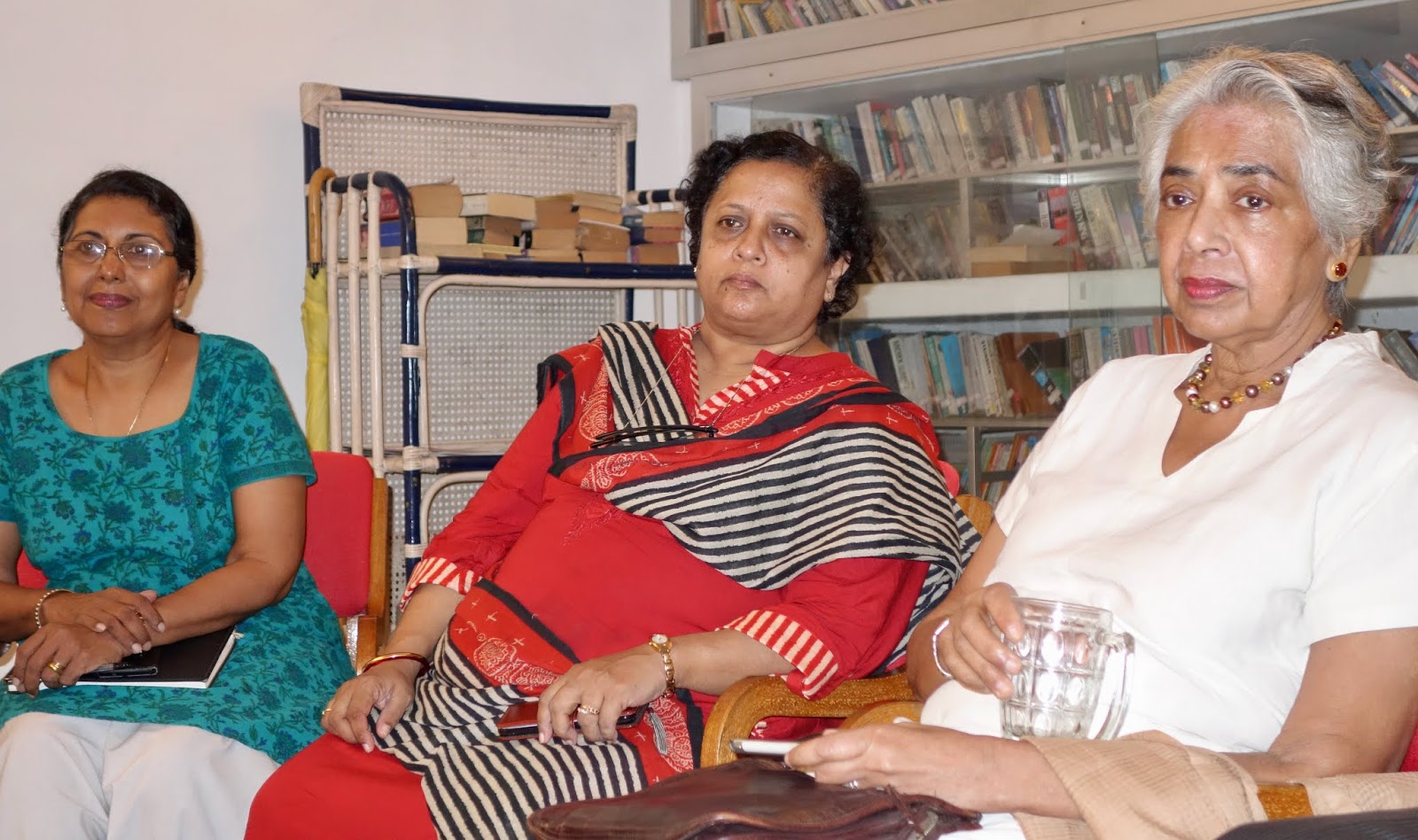
Here are some pictures taken by Geetha and Priya.

Shoba, Devika, Kavita, Geetha, Thommo, Priya Pamela (seated)

Sugandhi birthday cake

Geetha & Pamela having the good stuff

Goodies to eat - bhel and gobi bhaji (from Arundhaty), chicken patties, carrot cake and coconut cookies (from Pamela)

Kavita all smiles with the eats

Geetha & Pamela together


Tuesday, 11 June 2019

Spike Milligan – Puckoon, May 31, 2019


Puckoon 1963 edition

Comic adventures have featured in our reading every year. This time it was a novel by Spike Milligan, best known in Britain as the creator and writer of The Goon Show, a half-hour radio comedy that ran on BBC in the fifties, starring Spike Milligan, Peter Sellers and Harry Secombe. Milligan had a nervous breakdown from authoring scores of episodes over the years, but later he was given a bunch of comedy writers to assist him, preserving his brand of off-key humour.


Devika

Richard Attenborough who filmed the novel in 2002 said “When I first read it, I was laughing so much I was close to peeing.” The novel took the author three years to write. It is not so much a continuous story as an assortment of disconnected episodes threaded loosely by the narrative of gormless cartographers drawing a boundary between the Republic of Ireland and Northern Ireland. The central question of the boundary remains topical with the vexed Brexit issue in current British politics.


Saras discusses

Attenborough says, “Spike's humour was all about irreverence, … irreverence is an essential part of our culture. I admire that enormously.” Spike was meant to be in the film; however ill-health prevented his participating, though he saw the film before he died. His daughter Jane acted as the fierce wife of Dan Madigan.


Puckoon film poster 2002

Our readers concurred that the book was a riot of laughter almost all the way through. The individual pictures will bear testimony to their enjoyment, but here they are at the end, completely chortled out, barely a smile left with which to crease their faces. 


Geetha, Devika, Saras, Thommo, Geetha Joseph, Pamela, Priya, (seated) Hemjit

Monday, 15 April 2019

A Shakespeare Celebration – Apr 12, 2019

First Folio printed posthumously  in 1623 by fellow actors John Hemming and Henry Condell – 750 copies were printed, 235 survive today

For our annual Shakespeare event in the month of his birth (and death) we had the privilege of two of our staunch members from former times attending as guests: Talitha and Indira. This year it was also marked sadly by the first anniversary of the death of Bobby Paul George, who founded the Kochi Reading Group in 2005. His intellectual curiosity and love of literature infected those who attended early meetings. We continue to remake his legacy.


Geetha, Talitha, Indira

Everyone appreciated the added learning and insights brought in by our guests, and expressed the hope they could attend oftener, perhaps gracing poetry sessions, such as our Romantic Poets celebration in August.


Coat of Arms obtained for William's father, John Shakespeare, Glover, of Stratford-upon-Avon

William Shakespeare, the Player, applied and obtained this coat of arms for his father in 1596 from the College of Heralds in London. The central shield has a spear going through it. Joe, re-imagining it as a quill pen, adopted it for use as the Favicon, or website icon, of the KRG blog, as you will see in the tab of the browser at the top.


KumKum, Devika

Meanwhile news arrives that the theatre historian, Geoffrey Marsh, has identified the address in London where William Shakespeare lived at the height of his powers in 1598: 35 Great St. Helen's Street, hard by the modern landmark called the Gherkin.


1598 St Helens tax record, listing John Robinson the Younger, Prymme/Pryn and William Shakespeare

The attendance was at its best; thirteen were present, and two remote readers who could not attend submitted voice files. It has become routine now to con-celebrate birthdays with KRG readings. We had WS and Shoba to thank for an April birthday and the following goodies were on hand for Shakespeare’s 455th birth anniversary: kinnathappam and veg cutlets (Hemjit), barfi (Talitha), cake (Shoba), and pati sapta (KumKum).


Cake, Kinnathappam, Pati Sapta, Veg Cutlets


Kavita, Priya, Hemjit, KumKum

Zakia, Priya, KumKum, Devika

Here is the group at the end of a long but exhilarating session:


(Standing) Geetha, Devika, Kavita, Shoba, Zakia, Indira, Talitha, KumKum, Thommo, Priya (Sitting) Arundhaty, Hemjit, Joe


Tuesday, 9 April 2019

Philip Roth – American Pastoral, Mar 29, 2019

American Pastoral - first edition cover 1997

American Pastoral is Philip Roth’s twentieth work of fiction. In this work Roth introduced Nathan Zuckerman as a narrator and it continued for two other other novels in a trilogy; previously Zuckerman was himself a character in novels, with a marked similarity to Roth.


Group with Priya at back carrying grand-daughter, Anusha

The novel intends to portray the fulfilment of the American dream of having a perfect family, a house in the suburbs, prosperity, and a feeling of patriotic pride in America. The chief character, Swede Levov, has fought in WWII, returned to work in his father's business of glove-making and prospered, treating his workers fairly. He acquired a beauty queen as wife along the way.


KumKum, Devika, Geetha, Gopa

The novel is all about the shattering of the dream. Their only daughter, Merry, becomes caught up in the protest movement of the sixties against America's murderous involvement in the Vietnam War. She takes the extreme step of bombing a peaceful neighbourhood and killing an innocent doctor, and then following up with two more bombings.


Priya & Thommo having cake and sandwiches

Zakia smiling

The father-daughter relationship is severely tested. It spans several decades but if feels as though such things could happen in today's world too, racked with violence as it is, and unjustifiable wars by the powerful against the weak. In the latter half of the novel Swede, patient and understanding as a father, finds he is out of his league in the disorder and mayhem of sixties America.


Zakia, KumKum, Devika

All this is compounded with a dash of Jainism and Sallekhana (voluntary fasting to death) as Merry lives in squalor, while suburban adultery infects Arcadian America. All of it leaves Swede Levov unmoored from the staid rules he has followed throughout his life. How to make sense and cope.


Joe, Devika, Geetha, Shoba, Gopa, KumKum, Zakia, Thommo at the end - missing are Priya, Arundhaty, guest Papri, and Pamela who had to leave early

Thursday, 7 March 2019

Saadat Hasan Manto – Selected Short Stories, Feb 18, 2019


Manto - Selected Short Stories (MSSS) translated by Aatish Taseer is a good collection covering some of the author's famous stories. He wrote over 250 in his short life of 42 years, the last seven of which were spent in Lahore, after emigrating to Pakistan in Jan 1948.


Manto considered himself a Bombay writer, living and writing in close association with the city’s film industry for which he wrote stories and scripts. He had many close friends among film actors, and became a good friend of Ismat Chugtai, the woman short story writer for whom he had a high regard. She, like him, doubled as a screenplay writer for Bombay films. The amazing talent that the Bombay film industry drew at that time (and still draws) from all over India is the principal reason for its vitality.

Kochi Reading Group (plus one interloper, Gael)

Geetha, Devika, Kavita, Thommo, Hemjit

Hemjit & Sugandhi with KumKum

Manto wrote about everything and was not afraid to describe the seamy side of life, which he saw as intertwined with the normal surface respectability on the outside. He was a wonderful writer of women characters for whom he had a special empathy; in his public life he upheld the tenet of equality for women. The translator, Aatish Taseer, who learned Urdu in order to translate Manto, makes a significant point about the culture in which Manto was at home:


India must now reclaim men like Manto. In Pakistan, Manto’s world, crowded with Hindus, Sikhs, and Muslims, would feel very foreign. It is only in India, still plural, still symmetrically Hindu, that it continues to have relevance. His eye could only have been an Indian eye, sensitive to surprising detail, compulsively aware of Indian plurality, sympathetic to people trapped in their circumstances, here pointing to a particular Hindu festival, there imitating Bombay street dialect.

Many have considered it a tragedy that Manto went to Pakistan after Partition. His wife Safia explains the perplexity at the time that led to his decision, in the biographical notes below. The real tragedy was that he went to a country that did not appreciate his gifts, that tormented him with obscenity charges (on one occasion the use of the word ‘breasts’ was cited as obscene). Magazine publishers in Lahore routinely paid him on the cheap with bootlegged liquor. For decades he was persona non grata, until on the centenary of his birth the Government of Pakistan decided it was time to bestow an honour, the Nishan-e-Imtiaz medal.


Hemjit, Zakia, Saras, KumKum with birthday goodies - marble cake, samosas, and round Ferrero Rocher chocolates

Manto raised the issue of which side will own what part of the language and culture of north India. 

“Will Pakistan’s literature be separate from that of India’s? If so, how? Who owns all that was written in undivided India? Will that be partitioned too? Are India’s and Pakistan’s core problems not the same? Will Urdu be totally wiped out in India? What shape will it take in Pakistan? Will our state be a religious one?”

One thing we can assert with confidence. Urdu was never extinguished in India, but perhaps suffered a decline after the decades when poet-writers like Sahir Ludhianvi and Shakeel Badayuni provided lyrics for songs and dialogues for films. Now mushairas are once again alive in the North and even woman shayars like Malka Naseem, are being recognised in the country (see from 2:55 onwards of https://www.youtube.com/watch?v=ILKNHjiofb8). The young college folk are showing renewed interest in listening to Urdu poets at gatherings.  


Here is a group picture of the readers at the end of the session:

(standing) Joe, Arundhaty, Sugandhi, Zakia, Devika, Saras, Gael, Geetha, KumKum, Rachel Thommo (seated) Hemjit


Sunday, 27 January 2019

Harper Lee – To Kill a Mockingbird, Jan 21, 2019

First Edition Cover, 1960

To Kill a Mockingbird (TKAM) by Harper Lee has become a classic novel of young adult literature in America. Boys and girls read it in school as an assignment by the age of twelve or thirteen. Just as with other challenging books, attempts have been made to block it from juvenile readers, under one pretext or another. The vain attempt to stifle literature has now stopped.


KumKum and Devika

Perhaps TKAM owes its fame even more to the film that was released in 1962 within two years of the novel’s publication. Atticus Finch (AF) was played by Gregory Peck and the character of AF has more or less become identified with Peck. The identification was so complete, and the performance of such quality, that the author, Harper Lee, (who died in 2015) never gave her consent to a second movie version.


Pamela, Zakia, Kavita, and Geetha

In the law profession there has been a movement to identify the virtues of the legal profession with the grit and character shown by AF. He has been cited as a role model for lawyers. However, a debate was sparked in 1992 by professor of law, Monroe Freedman, in the Legal Times of Feb 24, 1992 pointing out several deficiencies of AF, courageous and skilful though he was in defending Tom Robinson, the accused black rapist.


Arundhaty and Thommo

Harper Lee has mined her own experiences of growing up in the South to give flesh to the characters and scenes in the book. The picture she paints of AF, a widower bringing up two spirited children, and imparting his discipline to them gently but firmly, has appealed to generations of readers. His kind demeanour allowed them to grow up with their individuality intact. We see them actually grow up during the two year period covered by the novel.


Priya

Here is a group picture of the readers:


(standing) Pamela, Zakia, Geetha, Arundhaty, Thommo, Priya, KumKum, Devika (sitting (Joe, Hemjit)


Friday, 14 December 2018

Happy Poems – Dec 7, 2018

Pamela, Geetha, Devika, Saras

This poetry session was announced as a year-end occasion to recite ‘happy’ poems. Readers therefore chose humorous poems for the most part; or poems exhibiting the lightheartedness of major poets who have shed their seriousness on occasion.

Saras, Hemjit, Shoba

It was a time to dress for the coming holiday season in gay clothes. Thommo was sure he would stand out as the most gaily dressed with his fancy blue silk shirt with coloured squares, but he didn’t reckon with the bold yellow, red, and black printed shirt Joe wore (of Thai origin, presented by his daughter, although it looked gorgeously African); and a turban wrapped with KumKum’s dupatta!

KumKum, Priya, Thommo

The women were colourfully dressed too, many in red for the season. Unfortunately, Priya arrived with such a bad case of voice lost, that she excused herself after wishing us in sign language, and left to recuperate from her pharyngeal stifle.

Pamela, Geetha, Devika

It was also an occasion to celebrate at year-end for having read six wonderful novels and a hundred or more moving poems through the year. Thommo arranged a dinner in the dining hall of the Yacht Club for readers and their partners  but no partners, other than reading members, could attend. Butter chicken, matar paneer, kadai mixed vegetable, and salad, followed by mango cheesecake was on the menu, with plenty of tandoori parathas and rotis.

Kavita, Pamela, Geetha, Devika, Saras

Joe and Kavita

We came up with the final list of six novels for next year and included an extra month to read short stories; this time, stories of the Pakistani author, Saadat-Hasan Manto translated from Urdu. That means we will have just five Poetry sessions in 2019.

Pamela & Geetha

At the end KumKum and Shoba pronounced it was a lovely session and here we are in a radiant group:

(standing) Joe, Kavita, Devika, Shoba, Zakia, Geetha, Pamela, Thommo (sitting) Saras, Hemjit, KumKum

Tuesday, 20 November 2018

Graham Greene – The Heart of the Matter Nov 16, 2018

Heart Of The Matter - First Edition, 1948


Greene in his epigraph to this novel quotes Charles Péguy to the effect that no one can know Christianity better than a sinner – unless it be a saint. 

Thommo, Geetha, Devika, Saras, Sudesh Jain, Priya

There is a lot about Catholicism in this novel which led to Greene being called a Catholic novelist, instead of a novelist who happened to be Catholic (which he preferred). The suicide ending the novel is made to appear as an irreconcilable conflict between Scobie's religious beliefs and and his sinful ways. But suicide is usually a result of clinical depression, complete despair, isolation, and seeing no way out of a morass of troubles. The other kind of suicide is the Japanaese seppuku, to retrieve honour in an extreme situation.


Sudesh Jain, Priya, KumKum, Zakia

Pity is a word much used in this novel (thirty-five times to be precise), and forms the basis for the marital bond, as well as the extra-marital foray of Scobie. Scobie has raised Pity to the level of a Cardinal Virtue, so that he may be called the Patron Saint of Pity. The depth of this feeling tears him apart when two pities are ranged on opposing parties.


Priya and KumKum

Equally, one may say it is Scobie's overweening sense of personal Responsibility for the happiness of others that lies at the root of his moral perplexity. It does not occur to him that people are quite capable of taking care of their own happiness (or unhappiness), and can reconcile with their own frustrations and unmet expectations. Søren Kierkegaard would say he is seeking spiritual and ethical integrity, but not focusing on it single-mindedly (cf. Purity of Heart Is to Will One Thing).

Sudesh Jain

Here are a few memorable quotations from the novel:
We are all of us resigned to death: it's life we aren't resigned to.

Friendship is something in the soul. It is a thing one feels. It is not a return for something.

The truth, he thought, has never been of any real value to any human being—it is a symbol for mathematicians and philosophers to pursue. In human relations kindness and lies are worth a thousand truths.

The group presented themselves at the end of the session, which included refreshments for Geetha's birthday; Zakia had to leave early. 


Geetha, Devika, Saras, KumKum, Priya (standing) Sudesh Jain, Joe, Thommo (sitting)